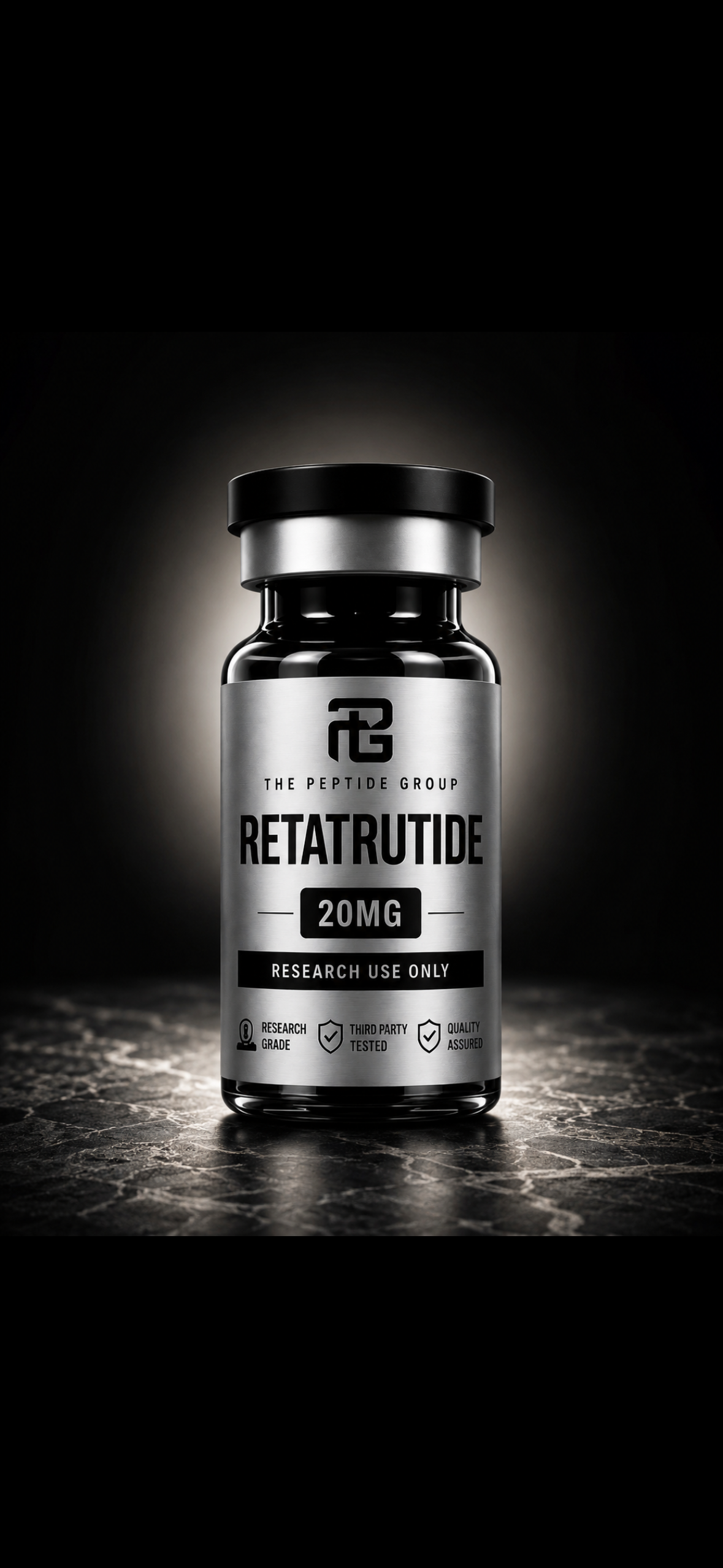
Retatrutide 30 Most Asked Questions
Retatrutide is one of the most talked-about next-generation metabolic peptides, but it’s also one of the most misunderstood. This guide answers the 30 questions researchers ask most—from how it works and what a triple agonist is to what current research actually shows.
What is a tripe Agonist ?
Imagine you’re the mayor of a city.
Every morning you call three people.
The police chief keeps the streets safe.
The fire chief responds when something goes wrong.
The public works director keeps the roads, water, and electricity running.
Now imagine one of them never answers the phone.
The city still works…
…just not as well.
That’s a lot like your body.
It isn’t controlled by one switch.
It’s thousands of conversations happening every second.
Scientists discovered years ago that talking to one metabolic pathway could change appetite.
Later they learned that talking to two could change even more.
Then someone asked a bigger question.
“What if we could call all three departments at once?”
That’s exactly what Retatrutide was designed to study.
Instead of communicating with one metabolic pathway, it communicates with three.
One helps regulate appetite.
Another helps coordinate how the body responds after eating.
A third influences how the body manages energy.
Each department has its own job.
None of them runs the entire city.
But together…
…they keep everything moving.
That’s why scientists call Retatrutide a triple agonist.
Not because it’s a fancy scientific term.
Because it’s a compound designed to have three conversations at the same time instead of one.
That’s what made researchers stop and pay attention.
2. How Does Retatrutide Actually Work?
Imagine your body is like a house with three smoke detectors.
One is in the kitchen.
One is upstairs.
One is in the garage.
If only one detector works, you’ll still get some warning when there’s smoke.
If two work, you’ll catch even more problems.
But when all three are working together, the house is simply better at recognizing what’s happening.
That’s the basic idea behind Retatrutide.
Your body is constantly sending messages between your stomach, brain, pancreas, liver, muscles, and fat cells. Those messages help determine when you feel hungry, when you’ve had enough to eat, how your body stores energy, and how it uses the calories you consume.
Retatrutide doesn’t force your body to do one thing.
Instead, it joins the conversation.
By interacting with three different metabolic signaling pathways, researchers are studying how the body responds when multiple systems receive coordinated signals instead of relying on just one.
Think of it like an orchestra.
A violin can play a beautiful melody by itself.
A trumpet can too.
So can a piano.
But when every section plays together, the music becomes something completely different.
That’s what scientists are exploring with Retatrutide.
Not whether one pathway matters.
They already knew it did.
The question is whether several pathways working together can create a response that’s different from any one of them acting alone.
That’s why researchers continue studying it so intensely.
Because the goal was never simply to make people eat less.
The goal was to better understand how the body’s entire metabolic orchestra plays together.
3. Why Do People Suddenly Stop Thinking About Food All Day?
Imagine you’re sitting in a movie theater.
The movie is great…
…but there’s a guy behind you who won’t stop talking.
Every few minutes he leans forward and whispers,
“Popcorn sounds good.”
Five minutes later…
“You know what would be amazing? Nachos.”
Ten minutes later…
“There’s candy right outside.”
The movie never changed.
The theater never changed.
The distraction did.
For many people, that’s what life can feel like around food.
Not hunger.
Not starvation.
Just a constant stream of reminders.
“Grab a snack.”
“Open the pantry.”
“Dessert wouldn’t hurt.”
“Start your diet tomorrow.”
Researchers often call this food noise—the ongoing mental chatter about eating. It isn’t simply an empty stomach. It’s the conversation happening between your brain, your habits, your environment, and the signals your body sends throughout the day.
One of the reasons scientists became so interested in compounds like Retatrutide is that many people describe this mental chatter becoming quieter. They don’t say food suddenly tastes bad. They don’t say cookies disappear. They simply describe feeling less consumed by the next meal or snack.
Researchers are still working to understand exactly why. The biology is complex, and not everyone experiences the same changes. But this reduction in food-related thoughts has become an important area of study because it may help explain why some people report eating differently without feeling like they’re constantly fighting themselves.
The refrigerator is still in the kitchen.
The cookies are still on the counter.
The movie is still playing.
The guy behind you finally stopped talking.
4. Why Do People Get Full After Just a Few Bites?
Ever go to Thanksgiving dinner and tell yourself,
“I’m eating everything.”
You load your plate.
Turkey.
Mashed potatoes.
Stuffing.
Rolls.
Pie is already waiting in the kitchen.
Then…
Halfway through dinner…
You lean back in your chair.
Undo the top button on your jeans.
And somehow say,
“I couldn’t eat another bite.”
An hour later…
…someone walks in carrying warm apple pie.
Miraculously…
…you find room.
So were you really full?
Or did your brain simply decide something different was worth making room for?
Scientists have spent decades studying that question.
It turns out your stomach isn’t just a storage bag.
It’s constantly sending updates to your brain.
“We’re getting pretty full down here.”
“Slow things down.”
“We’ve probably had enough.”
Those messages help determine when you stop eating.
Retatrutide is being studied because it appears to strengthen and coordinate some of those natural conversations. One reason is that it can slow how quickly food leaves the stomach. When food stays there longer, your brain continues receiving signals that a meal is still being processed. At the same time, the pathways Retatrutide activates are involved in regulating appetite and satiety—the feeling that you’ve had enough.
That’s why many people describe feeling satisfied with smaller meals.
Not because the stomach suddenly shrank.
Not because food became less enjoyable.
But because the conversation between the stomach and the brain may become clearer.
Your plate didn’t get bigger.
Your fork didn’t get smaller.
Your brain may have simply heard the words, “We’re full,” a little sooner than it used to.
5. Why Do Some People Say Alcohol Doesn’t Sound Good Anymore?
Imagine your favorite song.
You’ve heard it a thousand times.
Every time it comes on, you instinctively turn the volume up.
Now imagine one day…
…the same song starts playing.
Nothing is wrong with it.
You still recognize it.
But for some reason…
…you don’t feel like turning it up anymore.
That’s one of the most interesting conversations happening in metabolic research today.
Researchers didn’t originally study Retatrutide because of alcohol.
They were studying appetite and metabolism.
But as scientists learned more about GLP-1–based therapies, something unexpected began appearing in conversations, patient reports, and new areas of research.
Some people said they simply didn’t think about alcohol as much.
Others reported finishing one drink instead of several.
Some said the urge that had always been there suddenly felt… quieter.
Nobody had told them to stop.
Nobody had hidden the bottle.
They simply didn’t feel pulled toward it in the same way.
Scientists are now actively studying whether these observations are connected to how the brain processes reward and motivation. At this point, the evidence is still developing, and experiences vary widely from person to person. Some people notice no change at all, while others describe a meaningful difference.
That’s how science often works.
Researchers set out looking for one answer…
…and accidentally discover another question.
Whether those observations ultimately prove to be directly related to compounds like Retatrutide remains an active area of investigation.
But the fact that scientists are asking the question at all tells you something important.
Sometimes the biggest discoveries aren’t the ones researchers were looking for.
They’re the ones they never expected to find.
6. Why Do Some People Feel Nauseous?
Imagine your stomach is a restaurant.
Normally, it’s incredibly efficient.
Orders come in.
The kitchen cooks them.
The plates go out.
Tables are cleared.
The next customers are seated.
Everything moves at a steady pace.
Now imagine the restaurant suddenly decides…
“Let’s slow things down. Let’s make sure every table is completely finished before we seat the next guests.”
Nothing is broken.
The kitchen is still cooking.
The waiters are still working.
Everything is simply moving more slowly.
That’s one reason researchers believe nausea can occur.
One of the biological effects being studied with Retatrutide is slower gastric emptying—the process by which food leaves the stomach and moves into the small intestine. When that process slows, food stays in the stomach longer. For many people, that contributes to feeling full sooner and staying satisfied longer.
But there’s a trade-off.
If your stomach is already holding yesterday’s customers…
…today’s customers may not have much room.
That’s why some people feel overly full after only a few bites. Others notice nausea, especially when first starting treatment or after increasing a dose. Rich meals, large portions, or eating too quickly may make those sensations more noticeable for some individuals.
The important thing to remember is this:
Nausea isn’t necessarily a sign that something is “wrong.”
Often, it’s a sign that your digestive system is operating at a different pace than you’re used to. Experiences vary, and anyone with severe or persistent symptoms should seek guidance from a qualified healthcare professional.
Your stomach didn’t forget how to do its job.
It just started taking its time.
7. Why Doesn’t Everyone Lose Weight at the Same Speed?
Imagine handing ten people the exact same map.
Same roads.
Same destination.
Same starting time.
Do they all arrive together?
Of course not.
One driver hits traffic.
Another stops for gas.
One takes a wrong turn.
Another finds a shortcut.
The map never changed.
The journey did.
Your body works the same way.
People often assume that if two individuals take the same compound, they’ll get the same result.
That’s almost never how biology works.
Every person starts from a different place.
Age matters.
Genetics matter.
Muscle mass matters.
Sleep matters.
Stress matters.
What you eat matters.
How active you are matters.
Even your own hormones and metabolism change how your body responds.
That’s why researchers don’t look at one person’s results and call it science.
They study hundreds or thousands of people.
Only then do patterns begin to appear.
Retatrutide may help explain some of those patterns, but it doesn’t erase the fact that every body is unique. Two people can follow the same protocol and still experience different rates of weight loss, different side effects, and different timelines.
That’s not because one person “failed.”
It’s because biology has never been one-size-fits-all.
The goal of research isn’t to make every person identical.
It’s to understand why they’re different.
Science doesn’t compare one person to another.
It tries to understand why they’re never exactly the same.
8. If Retatrutide Is Slowing My Stomach Down… Why Would Scientists Ever Want That?
At first, it sounds like a terrible idea.
“Wait… you’re telling me my stomach empties slower? Why would anyone want that?”
Fair question.
Imagine trying to heat your house in the middle of winter.
Now imagine every time the furnace turns on…
…someone leaves every window wide open.
The furnace isn’t the problem.
The house simply can’t hold the heat.
Your stomach works a little like that.
If every meal rushes through your digestive system as quickly as possible, the signals that tell your brain, “We’ve eaten enough,” don’t have much time to do their job. Hunger can return sooner, and the body moves on to the next meal before it’s fully processed the last one.
One of the effects researchers study with Retatrutide is slower gastric emptying. That simply means food spends more time in the stomach before moving into the small intestine. During that time, your digestive system continues sending signals to the brain that digestion is still underway.
Think of it as the difference between reading one page of a book…
…or flipping through the entire chapter in ten seconds.
Your brain can’t absorb information it never has time to receive.
By slowing the pace of digestion, those natural fullness signals have more opportunity to be recognized.
That’s one reason many people report feeling satisfied with smaller meals.
It’s also why eating quickly or eating a very large meal can sometimes feel uncomfortable while the stomach is still processing what’s already there.
Researchers continue studying exactly how much this contributes to the overall effects observed with Retatrutide, because slower stomach emptying is only one piece of a much larger metabolic picture.
The goal was never to make digestion “lazy.”
The goal was to give your body’s own signals enough time to finish the conversation.
Sometimes the body doesn’t need louder messages.
It just needs enough time to hear them.
9. If Retatrutide Is So Powerful… Why Doesn’t It Work Overnight?
We live in a world of overnight shipping.
Instant downloads.
Thirty-second videos.
Everything is supposed to happen now.
Your body never got that memo.
Imagine planting an oak tree.
Would you walk outside the next morning expecting shade?
Of course not.
You’d probably laugh at the idea.
But somehow, people expect biology to work that way.
Your metabolism isn’t an app that installs an update while you sleep.
It’s trillions of cells constantly adapting to new information.
Every meal.
Every hormone.
Every night’s sleep.
Every workout.
Every stressful day.
They’re all part of the equation.
Retatrutide doesn’t flip one giant switch that suddenly transforms your body.
Researchers believe it changes the conversations happening between different metabolic systems over time. As those signals continue day after day, week after week, the body begins responding differently.
That’s why clinical trials measure progress over months—not days.
Scientists aren’t looking for dramatic changes after one injection.
They’re looking for consistent patterns that continue as the body adapts.
Some people notice appetite changes early.
Others notice fullness first.
Some don’t notice much at all until several weeks into treatment.
None of those experiences automatically mean something is wrong—or right.
Biology has never cared about our deadlines.
It moves at its own pace.
That’s why researchers don’t judge a compound by what happened on Tuesday.
They judge it by what continues happening months later.
Nature has never been in a hurry.
The strongest changes are usually the ones that take time to build.
10. If I’m Eating Less… Why Am I So Tired?
Imagine your body runs like a company.
For years, the accounting department has been receiving a million dollars every month.
Suddenly…
…that paycheck gets cut in half.
Does the company panic?
No.
The first thing it does is slow down.
It delays projects.
Cuts overtime.
Postpones purchases.
It becomes more careful with every dollar.
Your body does something remarkably similar.
When you begin eating significantly fewer calories, your body notices almost immediately.
It doesn’t know you’re trying to lose weight.
It doesn’t know you’re preparing for a beach vacation.
It doesn’t know you’ve been waiting years to fit into old jeans.
All it knows is this:
“Less energy is coming in.”
So naturally, it begins making adjustments.
Some people feel perfectly normal.
Others feel tired.
Some notice they don’t have the same energy in the gym.
Others simply want an afternoon nap.
Researchers believe several factors may contribute. Eating less means your body has less incoming energy to work with. Changes in digestion, hydration, sleep, electrolyte balance, and individual biology can also influence how someone feels. That’s why fatigue isn’t experienced by everyone—and why it can improve as the body adapts.
One of the biggest mistakes people make is assuming every symptom comes from the peptide itself.
Sometimes it’s simply the consequence of eating hundreds—or even thousands—fewer calories than the body was accustomed to.
Imagine driving across the country.
Yesterday your gas tank stayed full because you stopped at every station.
Today…
…you’re skipping half the gas stations.
Eventually the fuel gauge is going to notice.
Your body notices too.
Sometimes it isn’t running out of energy.
It’s learning how to spend it differently.
11. Why Doesn’t Everyone Experience the Same Side Effects?
Imagine ten people standing in the same rainstorm.
One gets soaked.
One barely gets wet.
One remembered an umbrella.
Another wore a raincoat.
The storm never changed.
The people did.
Your body works the same way.
People often ask,
“My friend had no nausea. Why do I?”
Or…
“Someone else lost twenty pounds in two months. Why haven’t I?”
Because your body isn’t your friend’s body.
Every person has a different metabolism.
A different digestive system.
Different genetics.
Different hormones.
Different eating habits.
Different sleep.
Different stress.
Even the bacteria living inside your gut are different.
Researchers expect variation because biology has always been variable.
That’s why clinical trials include hundreds or thousands of participants.
Scientists aren’t looking for one perfect response.
They’re looking for patterns across many different people.
The question was never,
“Will everyone respond the same?”
The question is,
“What usually happens… and why are some people different?”
Science advances by understanding the exceptions—not pretending they don’t exist.
The medicine may be the same.
The biology never is.
12. If This Works on Hunger… Why Are Scientists Studying So Much More?
When the Wright brothers built the first airplane…
…they weren’t trying to invent international travel.
They were just trying to stay in the air.
The rest came later.
That’s how science often works.
Researchers didn’t begin studying compounds like Retatrutide because they were curious about food noise.
Or alcohol.
Or reward pathways.
They were studying metabolism.
Then something interesting happened.
People began describing changes that weren’t part of the original question.
Some talked less about hunger…
…and more about how peaceful eating suddenly felt.
Others described thinking less about alcohol.
Some simply said…
“I stopped obsessing.”
Scientists don’t accept stories as proof.
But they do treat them as clues.
Enough similar observations can inspire entirely new research.
That’s exactly what’s happening today.
Researchers are asking whether the same biological pathways involved in appetite might also influence other reward-driven behaviors.
The answers are still being written.
But history is full of discoveries that started exactly this way.
Not with certainty.
With curiosity.
The best discoveries often begin as someone saying…
“That’s strange…”
13. If Retatrutide Is So Effective… Why Isn’t Everyone Taking It?
If someone built a car that got 500 miles per gallon…
…the next question wouldn’t be,
“Where do I sign?”
It would be,
“How safe is it?”
“How long has it been tested?”
“Will it still run five years from now?”
That’s exactly how science works.
Researchers don’t discover something interesting on Monday and declare victory on Friday.
They challenge it.
Question it.
Try to prove it wrong.
Again.
And again.
Retatrutide has produced findings that have generated significant scientific interest, but that’s precisely why larger and longer studies are conducted. Researchers want to understand not only what happens over months, but what happens over years. They study who responds well, who doesn’t, what side effects occur, and how benefits compare with potential risks.
Good science is patient.
Because patients deserve science that’s good.
Excitement starts research.
Evidence finishes it.
14. Why Can’t Scientists Just Tell Us Exactly What Will Happen?
Imagine asking a meteorologist…
“What’s the weather going to be on July 18th, five years from now at exactly 2:17 PM?”
They’d laugh.
Not because they’re bad at their job.
Because biology—like weather—is incredibly complex.
Scientists can tell you what usually happens.
They can tell you what happened in carefully conducted studies.
They can tell you what patterns consistently appear.
What they can’t honestly do is promise exactly what one individual will experience.
That’s not a weakness.
That’s honesty.
Every person brings different genetics, different health conditions, different diets, different medications, different sleep, different stress, and different biology into the equation.
Science deals in probabilities.
Not promises.
That’s why responsible researchers talk about evidence…
…not guarantees.
Anyone who promises certainty in biology usually understands neither.
15. What’s the Biggest Misunderstanding About Retatrutide?
Most people think Retatrutide is about…
weight loss.
Researchers increasingly think it’s about something much bigger.
Understanding metabolism.
For decades, scientists knew appetite wasn’t controlled by one hormone.
They knew metabolism wasn’t controlled by one organ.
They knew hunger wasn’t simply a lack of willpower.
Retatrutide didn’t create those discoveries.
It became one of the tools helping researchers explore them more deeply.
That’s an important difference.
Compounds come and go.
Good science lasts forever.
Years from now, researchers may look back and remember Retatrutide not only because of the results reported in studies, but because it helped ask better questions about how the human body regulates appetite, energy, and metabolism.
The story has never been about one peptide.
The story has always been about understanding ourselves.
The greatest discoveries don’t just change treatments.
They change the questions scientists ask next.